Bent Wood Furniture: Origins & Prospects — The Past and Future of Curved Woodcraft


The pursuit of ergonomic comfort and distinctive streamlined shapes stands as the core pursuit of modern furniture design. Featuring high malleability and stable structure, bent panels have become mainstream base materials across the industry. Though the term “bent panel” is widely used within trade circles, comprehensive and clear explanations are rarely accessible to the public. Combining industrial documents and field visits to source manufacturers, this article systematically sorts out the definition, development timeline and future prospects of bent panels.
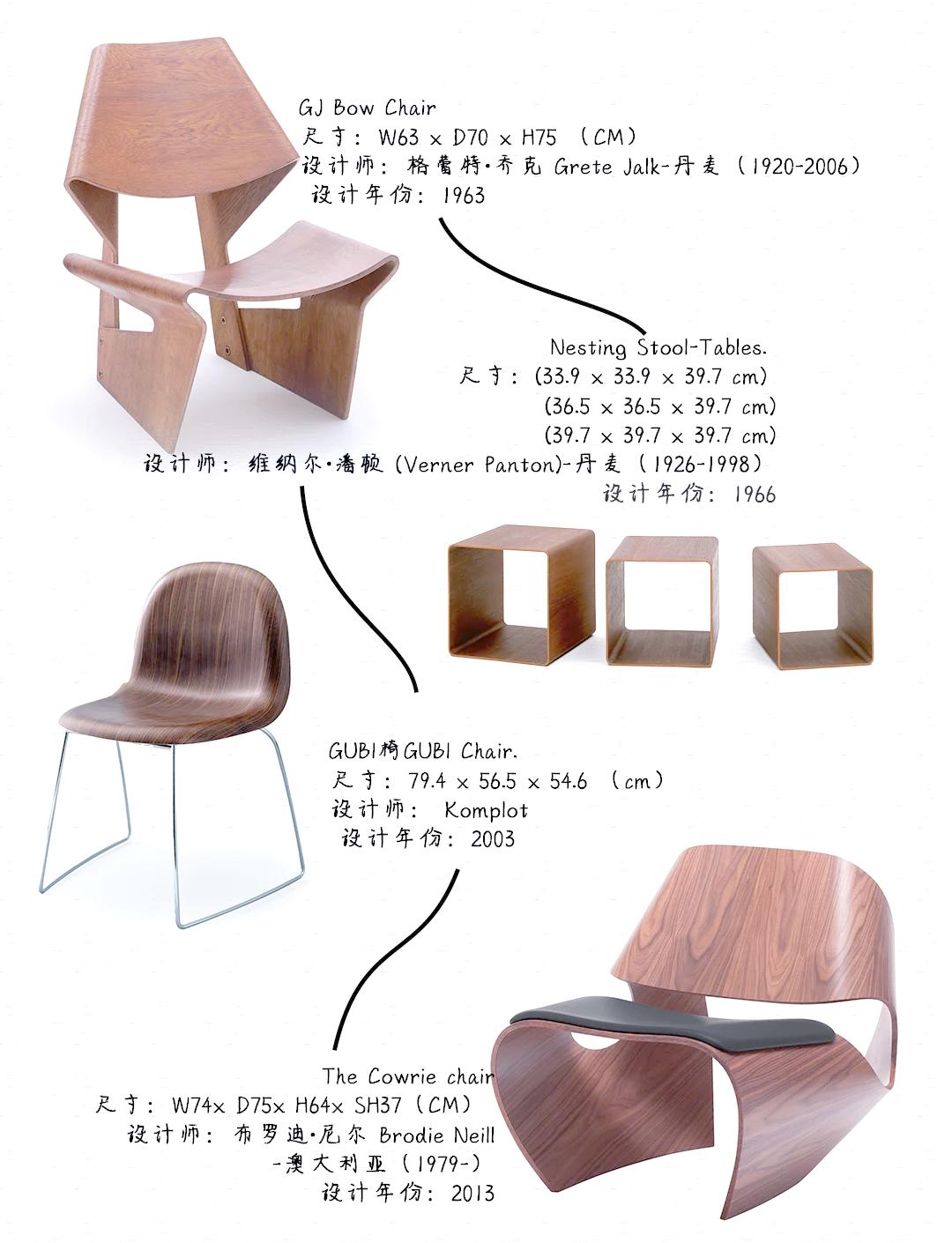
“Bent panel” is a general industrial term referring to wooden components shaped by hot pressing and bending. Its official technical name is moulded plywood, which is integrally formed under high temperature and pressure with dedicated moulds. Essentially, it is a multi-layer composite board built upon common plywood (multi-layer board). Logs are rotary-cut into thin veneers. After drying and gluing, veneers are stacked with grain directions perpendicular to adjacent layers and bonded under high temperature and pressure. Plywood is among the earliest man-made boards to achieve industrial production.
The prototype of plywood dates back to 3000 BC in Ancient Egypt, when thin wood veneers were exclusively used as decorative surfaces for royal artifacts and regarded as rare ornament materials. The craft evolved slowly for millennia until technological breakthroughs arrived during the Industrial Revolution. In 1812, a French craftsman obtained the patent for the first veneer saw, which was put into mass production more than a decade later. In 1834, Charles Picot from France invented the veneer slicer and secured its patent; nearly thirty years were spent to realize its industrial application.
The invention of the rotary lathe served as a key driving force behind the boom of the plywood industry, yet its origin remains debated. Professor Fessel from Russia developed relevant equipment in 1819; British engineer Favier obtained a patent in 1840; Carand of France filed another rotary lathe patent in 1844. In the mid-19th century, the world’s first veneer processing factory was established in Germany, mostly equipped with machinery imported from France and the United States. After 1870, Berlin-based A.Roller Company began independent mass production of simplified rotary lathes. Continuous upgrades to rotary cutting technology steadily improved plywood quality, bringing the material into mainstream markets.
During World War I (1914–1918), plywood was formally designated a standardized commercial product, marking the start of large-scale industrial production and laying a solid technical foundation for the emergence of bent panel furniture. Built on mature multi-layer plywood bonding technology, bent panels overcome natural wood’s drawbacks such as cracking and poor shaping performance. They enable integral forming of smooth curved surfaces, perfectly matching ergonomic requirements for chairs, cabinets and other furniture.
Looking back, the evolution of bent panel furniture has always followed innovations in plywood manufacturing. In the years ahead, soft curved designs are gaining growing popularity in residential and commercial spaces. Rising consumer demands for furniture comfort, customized styling and eco-friendly materials, alongside advances in automated moulds and digital hot pressing techniques, will continuously expand the market for bent panel furniture, ushering in a brand-new era for curved woodcraft.
下一篇:
没有了!
Copyright © 2026 广西容县千大木业有限公司 备案号:桂ICP备2026014937号-1